
Baltimore County VINE Coverage
Maryland VINE through VINELink is a free custody, court, and supervision notification service. Official Maryland material describes events from District and Circuit Courts, local detention centers, the Division of Correction, parole, and probation. That reach matters in Baltimore County because the Baltimore County Detention Center is operated by the County Department of Corrections, while state prisons and community supervision are run through Maryland DPSCS. A person can move from one reporting source to another without staying in one continuous online record.
VINE can supply status language, a source or housing location, and a release or other custody-change notice when the participating source sends the event. It is useful for a known person, not for building a list of everyone released. The Baltimore County Detention Center publishes no public roster or historical release search, so VINE is one of the few quick status channels available before a formal county records request. Its result still needs careful reading. “Released” from BCDC may mean a community exit, but the county movement record could instead show a transfer to DPSCS, another county, federal custody, or immigration custody.
Search Baltimore County VINE Records
Start with the direct Maryland VINE experience. Search only after confirming that Baltimore County, rather than Baltimore City, is the right jurisdiction. The two are separate. BCDC is in Towson and belongs to Baltimore County government. A state correctional result, meanwhile, comes from DPSCS. Comparing the reporting source prevents a same-name record or a Baltimore City detention record from being mistaken for the person sought.
- Select Maryland and choose the custody or offender search that matches the inquiry.
- Enter the full name or identifier offered by the live interface. Try a verified spelling and lawful identifier when a common name returns several people.
- Compare the reporting facility, source, available identifiers, and status. Do not select a result on name alone.
- Open the matching record and read its exact custody wording, location, and event information.
- If release appears, check the Baltimore County court case and ask BCDC or DPSCS for the corresponding movement or release record.
The broader Baltimore County released-inmate search path helps when VINE returns no match. It routes a county stay to BCDC and the court docket, a state term to DPSCS records, and federal or immigration custody to the correct federal locator. A no-result should begin that next check, not end it.
The live Maryland VINE search screen shows why selecting the right state and source is part of the identity check.
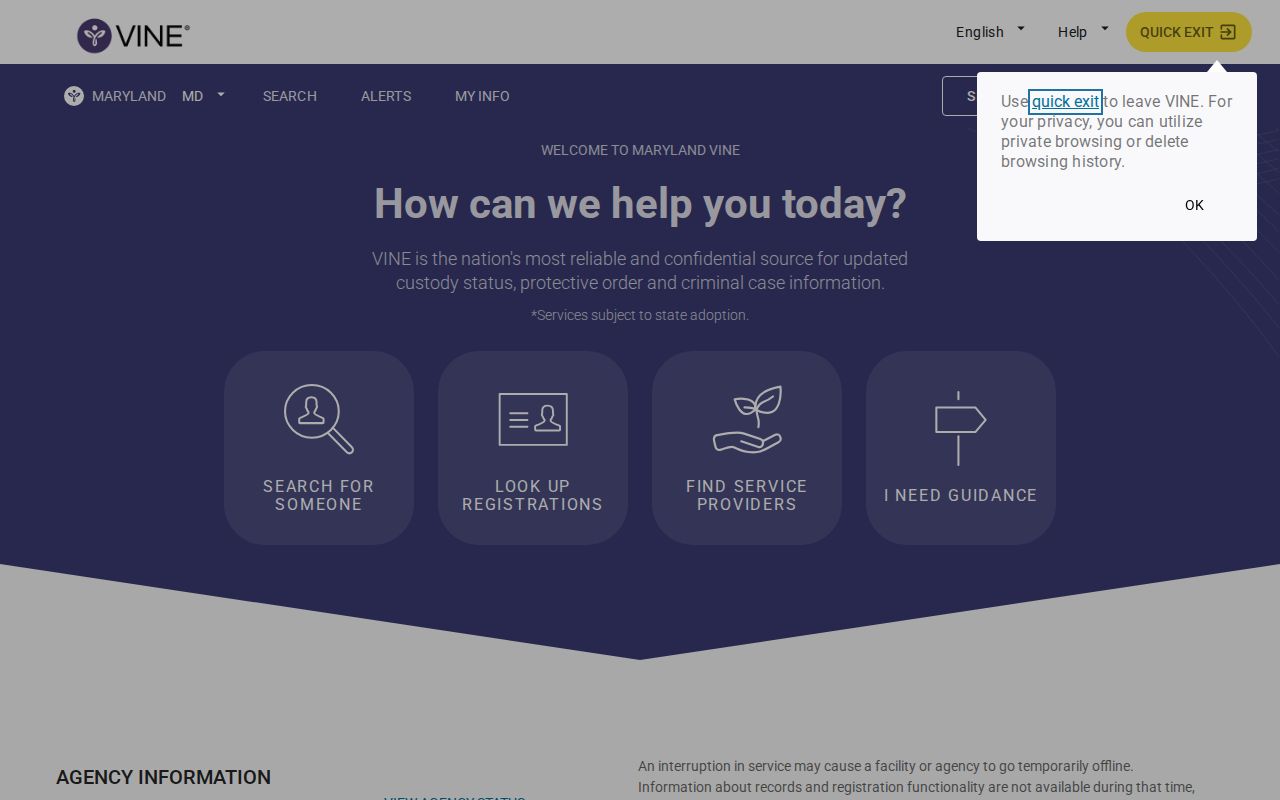
The search interface is a routing tool; the matched facility and status supply the context needed before relying on the result.
Note: Match the facility, jurisdiction, and available identifiers before acting on a Baltimore County VINE result with a common name.
Baltimore County VINE Release Fields
What appears depends on the source feeding the record. Maryland material supports custody status, housing or reporting location, release-date information, and registration for selected court or custody events. It does not promise a fixed released-record retention period. It also does not turn VINE into the detention center’s official movement ledger. Use the fields as leads that point to the right custodian.
| Field or event | What it can establish |
|---|---|
| Name and identifier | Helps distinguish the intended record, but should be checked against more than a name. |
| Custody status | Reports the status supplied by the participating jail, corrections, court, or supervision source. |
| Source or location | Shows which agency or facility is reporting and helps separate county from state custody. |
| Release or status event | Signals a source-reported change that should be confirmed through the originating record. |
| Release date | May appear when the source supplies it, but is not a permanent certified history. |
| Notification options | Shows the methods available for registering for future events on that record. |
A result that still lists BCDC supports current reported county custody at the time of the feed. A DPSCS facility points to state custody, not release from all confinement. If VINE says the person left the county jail, the BCDC release entry should distinguish a community discharge from a transfer. For an old event, the county’s Daily Desk Report, Locator Card Index, base file, or Monthly Release List is stronger historical evidence than a VINE screen.
Register Baltimore County Release Alerts
Registration attaches an alert to a specific custody or court record. Maryland materials allow methods such as telephone, text, email, TTY, or app notification when offered by the interface. The option set may differ by event and source. Registration is confidential, and the subject is not told who registered. Because calls may arrive at any hour, use contact details that can receive urgent notices.
- Open the matched Maryland custody or court record and select its notification or registration option.
- Choose the event and available delivery method. Maryland literature permits registration of more than one telephone number or email address.
- For telephone registration, create a four-digit PIN. Older official instructions state that email registration does not require that PIN.
- When an automated call arrives, listen to the message and enter the PIN followed by the pound key to acknowledge it.
- If the call is missed, follow the repeat message or contact the toll-free operator. Use the operator route to reset or cancel a forgotten PIN.
- Update changed contact details and re-register if the person shifts from local custody to state custody, court systems, or supervision.
The official Maryland VINE line is 1-866-634-8463, with TTY at 1-866-847-1298 and operator service available at all hours. The official brochure says an unanswered telephone notice may be retried for at least a day or until PIN acknowledgment. Automated notice can fail, so keep the relevant court, facility, or victim-service contact as a second channel.
Choose the event with care. A custody-change alert can report a release, escape, or other source-defined status change, while a court notice concerns activity in the case. A parole or probation alert concerns supervision and is not the same as confirmation that the person physically left a facility. If the goal is to meet someone after a Baltimore County release, call BCDC rather than using an alert to infer an exit door or pickup time. No official release-processing hours or designated waiting point were found.
Baltimore County VINE Transitions
Maryland’s notification layers are broad, but they are not one seamless file. Official sources conflict on transfer notice. Current DPSCS victim-service material says VINE does not inform users of transfers between institutions, while an older Maryland brochure describes transfer alerts and tells users to register again when the source changes. The cautious practice is to search and re-register whenever a Baltimore County detainee moves to DPSCS, a court matter changes levels, or custody becomes parole or probation supervision.
Written Division of Correction victim notification is also separate from VINE registration. Its Victim Services Unit uses a distinct notification request and can be reached at 1-866-606-7789. Registering in VINE does not prove enrollment in that written program, and the reverse is also true. The DPSCS Victim Services explanation supplies the current agency route and cautions users against relying on one automated channel.
The official DPSCS Victim Services view also highlights the local-to-state transition problem.
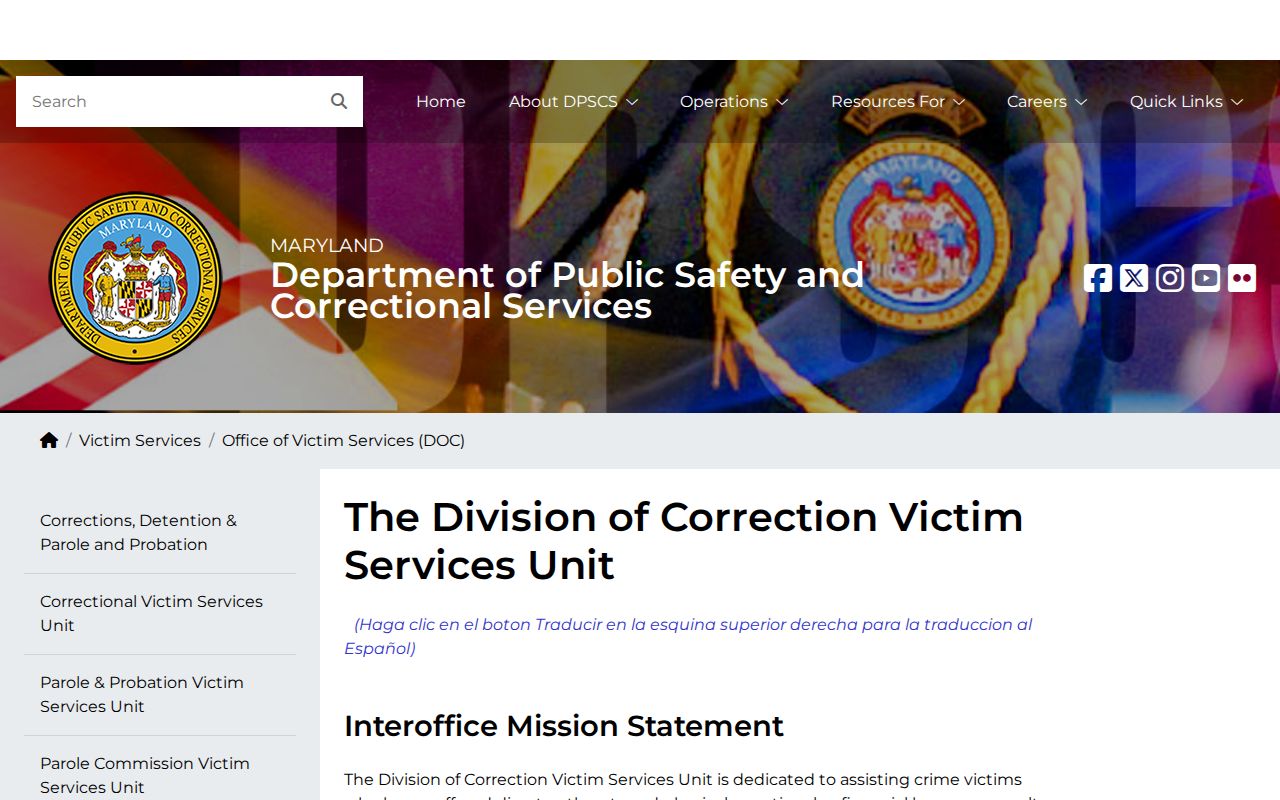
That state layer should be treated as a separate registration path when a person leaves Baltimore County custody for a Maryland prison.
Note: Re-search and re-register after each custody or supervision transition because Maryland materials do not promise seamless transfer tracking.
Baltimore County VINE Release Limits
VINE is not a federal locator, a complete court file, or an archival certificate. A federal sentence belongs in the Bureau of Prisons locator. A federal pretrial transfer may require the court docket or U.S. Marshals record. Current immigration detention belongs in ICE’s locator. Those systems can receive someone after Baltimore County custody ends, so a VINE release event cannot rule out another custodian.
Maryland’s DPSCS Incarcerated Individual Locator is also narrower than many readers expect. It shows covered people currently housed in specified state facilities. DPSCS expressly says people no longer in custody because of release or escape are omitted. It provides no historical released profile, public release date, supervision status, or projected date. Therefore, neither a VINE miss nor a DPSCS miss proves lawful community release.
A Baltimore County court docket can confirm a release order, bail action, sentence, or probation term, but not the exact moment the jail door opened. VINE can corroborate an event, yet only the custody record resolves processing time and holds. Where the record says “released to detainer,” check the receiving agency. That phrase means one legal custody ended and another began.
Baltimore County Release Proof
For an exact past BCDC release, write to the Baltimore County Department of Corrections at 720 Bosley Avenue, Towson, MD 21204, call 410-512-3200, or use Baltimore County’s Public Information Act request route. Identify the person, the approximate stay, and any known BCDC or case number. Ask for the releasable release entry, actual date and time, release type, and transfer destination.
A court order plus the BCDC movement record is the best pair for a county release. For state custody, use the DPSCS Public Information Act process to seek commitment, computation, release, or discharge fields. VINE remains valuable for fast alerts and routing, but the agency record is the source for a durable historical answer.
The Baltimore County courts directory routes users to the proper clerk, while Maryland Judiciary Case Search adds the legal context. Match the case number, charge disposition, release or bail action, sentence, and later warrant entries. The docket is not a jail movement log, but it can explain why VINE shows a change and can identify the authority behind it. When the docket and VINE date differ, ask BCDC whether one is the order date and the other is the processed physical release.