
Baltimore County Release Date Types
A projected date is the corrections agency’s current calculation of when a custodial term may end or reach a release point. It can incorporate the imposed sentence, presentence credit, applicable diminution credits, and later changes. An actual release date records what happened after staff processed the order, checked other cases and detainers, and completed the physical movement. A court order date, a projected date, and the time a person leaves Baltimore County Detention Center can therefore differ.
Pretrial detention works another way. Someone awaiting trial does not have a sentence-based projected date. The court may authorize release on recognizance, unsecured or secured conditions, or bond, but BCDC still must process the order and determine whether another matter holds the person. The court docket answers what the judge ordered. The BCDC movement record answers when and how county custody ended.
Find Baltimore County Projected Dates
Begin by identifying the custodian and the sentence source. BCDC holds county pretrial detainees and locally sentenced people. Maryland DPSCS handles state commitments. A federal sentence belongs to the Bureau of Prisons, not either local system. The Maryland Judiciary Case Search guidance explains that the public docket is a summary, so obtain the underlying order when its wording controls the computation.
- Find the correct Baltimore County criminal case and read the sentence, suspended portion, credit language, and later modifications.
- Decide whether the person remains at BCDC, was committed to DPSCS, or moved to another custodian.
- For a local sentence, ask BCDC for the sentence computation, diminution report, and present projected or mandatory release calculation.
- For a state sentence, use the DPSCS records process and ask for the commitment, sentence computation, maximum expiration, credits, and anticipated or mandatory release calculation.
- Ask whether another sentence, warrant, detainer, or transfer changes the expected community-release date.
- Near the date, confirm the actual custody event through VINE and the releasing agency.
The full Baltimore County release-record search helps locate the court, BCDC, VINE, DPSCS, BOP, or ICE channel that fits the custody history. It is especially useful when a person has left the first facility but may still be held elsewhere.
Note: Request the agency’s own computation for the individual rather than trying to calculate a Baltimore County release date from statutes alone.
Baltimore County Locator Date Limits
Maryland’s public tool is the DPSCS Incarcerated Individual Locator. It is a current-housing locator for a limited covered population, not a sentence-history database. Its application requires a first and last name. DPSCS warns that some people in its custody may not appear and that people no longer in custody because of release or escape are omitted.
The public result has no projected, tentative, anticipated, or mandatory-release date field. It also has no historical “Released” profile. An absent name cannot be converted into a past or future release date. If a state sentence is involved, use the DPSCS Public Information Act request and name the exact computation fields needed. If the person only served time at BCDC, direct the request to Baltimore County instead.
Baltimore County Pretrial Release Dates
For a person held before trial, the useful records are not a sentence calculator. Search the Baltimore County case for a bail review, recognizance order, secured or unsecured conditions, dismissal, nolle prosequi, or another release action. Then ask BCDC whether the order was received, whether processing was complete, and whether another case or detainer prevented community release. A favorable court action can coexist with a different hold.
Pretrial Services and Alternative Sentencing are parts of the Baltimore County corrections structure, while the court supplies the release authority. A home-detention placement or other community-based condition may end physical jail custody without ending court supervision. The docket supplies the order and conditions. The BCDC record supplies the movement date and destination. If the person was transferred to state, federal, immigration, or another county custody, that movement is not a community release date.
When timing matters, request the event date, the time staff entered or received the order, and the actual release time. Court staff may enter an order before detention staff verify identity, calculate the local term, and clear holds. A docket screenshot cannot replace that operational record. For a person-specific answer, the narrow request is usually faster and more useful than seeking a list of all people released on a given day.
Maryland State Release Credits
A DPSCS computation can start with the imposed term and whether multiple terms run together or back to back. It then accounts for presentence custody credit under Criminal Procedure §6-218, nonparoleable portions, the offense and its date, statutory credits, losses or restorations, parole action, detainers, and later sentences. “Diminution credit” means a lawful deduction from the term for defined conduct or activity. It is not the same as a court reducing the sentence.
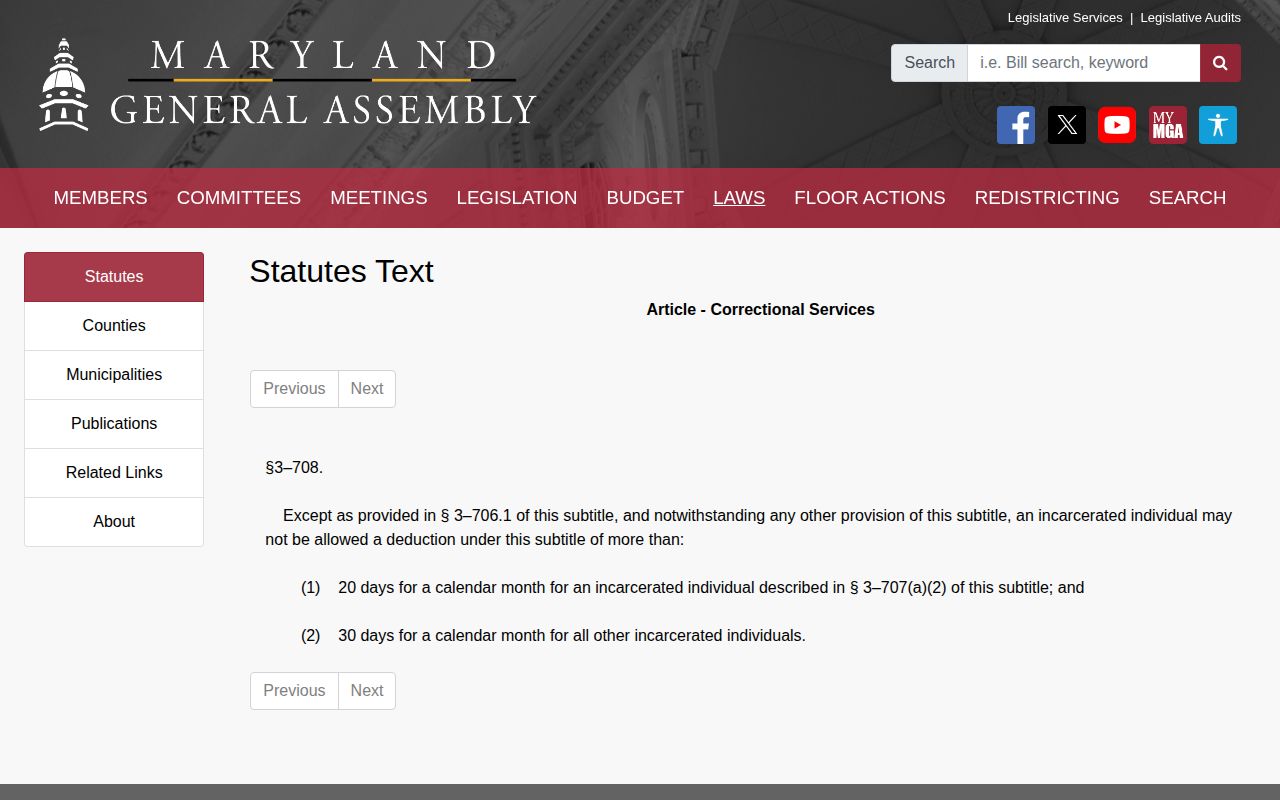
Correctional Services §3-704 generally provides ten good-conduct days per calendar month, prorated, but provides five days when the aggregate term includes a listed crime of violence or specified controlled-substance offense. Sections 3-705 and 3-706 may add work-task and education or treatment credits. Section 3-707 addresses special-project credit. The monthly cap in §3-708 generally limits the total, apart from the identified educational award, to twenty days for restricted categories and thirty for others. The individual credits cannot simply be stacked without that cap.
The official §3-708 statute view shows the cap that must be applied to a state calculation.
That state framework belongs to a DPSCS term, not automatically to a sentence being served in the Baltimore County Detention Center.
Baltimore County Local Release Credits
Local BCDC credit is governed by a different title. Correctional Services §11-503 provides five days per month of qualifying presentence local-facility credit, prorated, under its discipline and labor conditions. That local credit period ends on local sentencing, commitment to the Division of Correction, or release. Section 11-507 permits due-process revocation of certain local good-conduct credits.
Do not apply the DPSCS Title 3 rate to a BCDC stay. The Baltimore County Schedule C-800 identifies a Monthly Release List package that includes a diminution report and a loss-of-good-time log. A person-specific request can seek that report, the base-file release page, and the calculation used for the current date. If BCDC uses a successor database name, ask for the current record that performs the same function.
For state terms longer than eighteen months, Correctional Services §7-501 addresses conditional release when the term less applicable credits has been served, subject to its limits. Conditional release ordinarily begins a supervised status; it does not erase the balance of the legal sentence.
Note: Baltimore County local credits and Maryland state credits use separate statutes, records, and custodians even when the same court case is involved.
Baltimore County Release Date Changes
A projected date is a live calculation. It may move earlier or later when the inputs change. The reason should come from the computation record, court order, disciplinary record, parole action, or detainer disposition rather than guesswork.
| Factor | Possible effect | Best confirming source |
|---|---|---|
| Custody credit correction | Adds or subtracts time credited before sentencing. | Court order and agency computation |
| Credit earned or lost | Changes the term less available diminution credit. | BCDC or DPSCS credit record |
| New or consecutive sentence | Extends or restructures the aggregate term. | Court judgment and computation |
| Appeal or modification | May alter the lawful sentence being computed. | Court docket and signed order |
| Parole action | May create an earlier conditional release route or leave the term unchanged. | Parole Commission action and custody event |
| Detainer or hold | Can prevent community release or cause transfer to another custodian. | Sending record and receiving agency |
| Recalculation | Corrects offense, date, credit, cap, or sentence data. | Revised agency computation |
A parole hearing date is not a release date. Approval may include conditions that must be completed first, and physical release follows only after the prison clears the case. Likewise, a BCDC court-release order can be delayed by processing or another hold. Ask for the event date, entry date, and release time when the records seem to disagree.
A missing DPSCS locator result cannot settle the change. The person may have been released, escaped, excluded from the public tool, moved to county or federal custody, or entered under a spelling that does not match the query. Use VINE for a status event, the court for the legal action, and the proper custody record for the final movement. Each source answers a different part of the date question.
Baltimore County Percentage Myths
Maryland has no blanket rule that every incarcerated person must serve eighty-five percent. A rough percentage derived from one credit rate ignores other credits, statutory caps, custody credit, offense classifications and dates, mandatory minimums, credit loss, parole, and consecutive sentences. It cannot predict a Baltimore County projected release date.
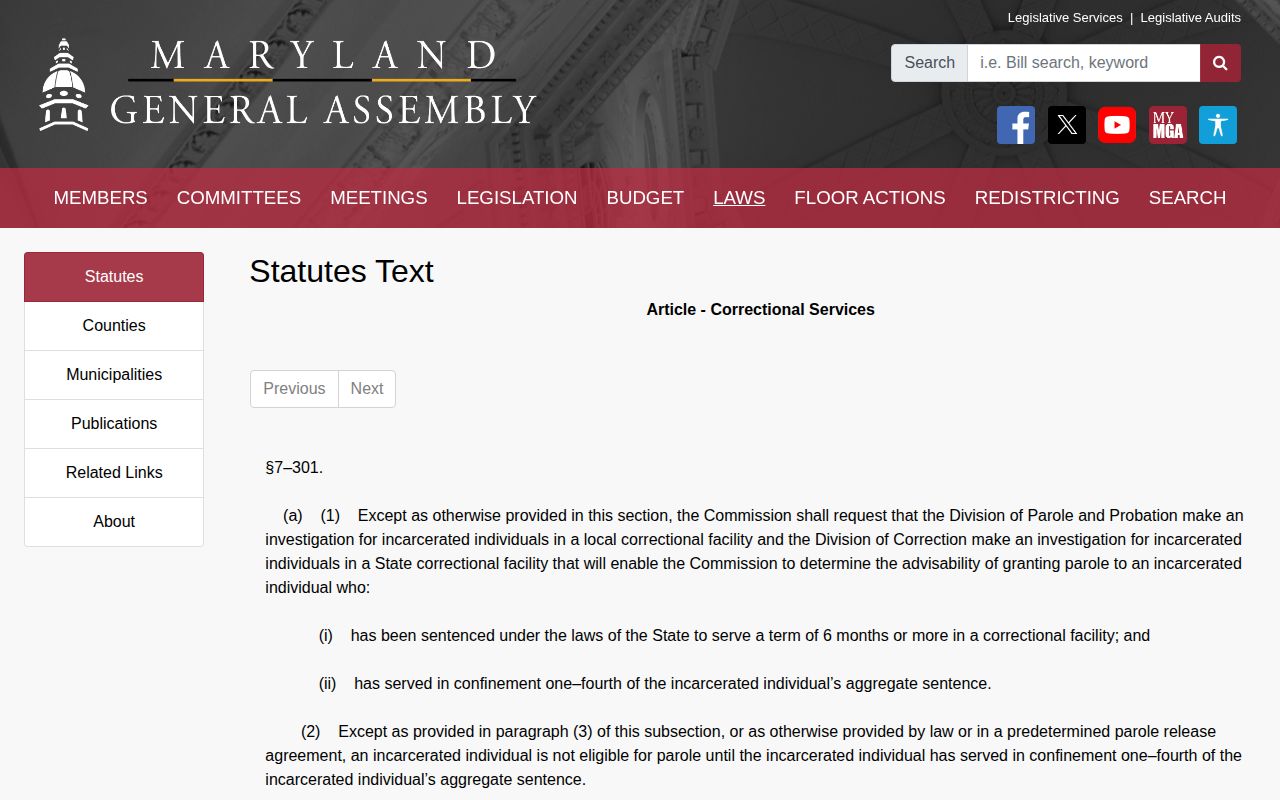
The often repeated fifty-percent figure concerns parole eligibility for specified violent offenses, not a guaranteed exit. Under Correctional Services §7-301, the general threshold is ordinarily one-quarter of the aggregate term, subject to exceptions. For covered violent offenses committed within the statute’s date rule, eligibility generally uses the greater of one-half of the aggregate violent-crime term or one-quarter of the total aggregate. Eligibility only permits consideration. It does not compel approval or establish the day of physical release.
The official parole-eligibility statute displays the rule that is often mistaken for a release guarantee.
Only the court and responsible corrections agency can apply those rules to the person’s sentence and credited time.
Confirm Baltimore County Release Dates
Near an expected date, use a Maryland VINELink release alert as a timely signal, then confirm with the agency that holds the person. For BCDC, the narrow request should seek actual release date and time, release authority or type, and destination. The Baltimore County Department of Corrections is at 720 Bosley Avenue, Towson, MD 21204, and the main number is 410-512-3200.
For a DPSCS term, request the releasable commitment and release record plus the final sentence computation. Compare the actual event with the court docket and any supervision record. A parole or conditional release means the person may be out of custody while still serving the sentence under supervision. A transfer entry means the first facility released the person to another custodian, not necessarily to the community.