
Baltimore County Release Meaning
Release from the Baltimore County Detention Center means the County's custody episode has ended, but it does not always mean the person is free of every form of custody or legal control. A person may leave after posting bond, receiving a court-ordered pretrial release, completing a local sentence, obtaining a favorable disposition, or moving to supervised placement. Another record may show a transfer to the Maryland Department of Public Safety and Correctional Services, another county, the U.S. Marshals Service, or U.S. Immigration and Customs Enforcement. The destination field and release type therefore matter as much as the date.
Baltimore County Department of Corrections operates the detention center at Towson; it is not a sheriff-operated jail and should not be confused with Baltimore City detention facilities run by the State. Once a person leaves BCDC, there is no official Baltimore County historical inmate-search page preserving the stay. The evidence is distributed among Corrections records, Maryland VINE, the Judiciary case record, supervision offices, and a receiving agency's locator. A reliable search follows the custody path rather than assuming one database covers every release.
Baltimore County Release Routes
The same word can describe several operational outcomes. Bond or a pretrial order ends the immediate detention episode while the criminal case continues. Time served or sentence completion relates to the court-imposed term. Parole and mandatory or conditional release may place a state prisoner in the community under continuing supervision. A transfer closes custody at the sending facility but begins custody elsewhere. Dismissal, acquittal, or release without charge concerns the case outcome and may create a later expungement route, yet the physical exit may still await processing and checks for other holds.
| Release entry | What it usually means | Best next source |
|---|---|---|
| Bond or pretrial release | BCDC custody ends while court conditions and the case may continue. | BCDC release entry and Maryland Judiciary case record |
| Time served or local sentence completed | The local term has reached its authorized end. | BCDC computation or release record and sentencing order |
| Parole or conditional release | The person may be in the community under state supervision. | Maryland Parole Commission and Division of Parole and Probation |
| Transfer | County custody ended, but custody may continue with a named receiver. | Destination field, then the receiving agency's locator |
| Release without charge or favorable disposition | Custody ended and an expungement process may apply. | BCDC entry, court file, and current Judiciary guidance |
Baltimore County Release Record Fields
The most useful local sources are named in Baltimore County Bureau of Corrections Records Retention Schedule C-800. The inmate base folder may connect commitments, writs, dispositions, detainers, property documents, photo identification, and a chronological history through release. The Locator Card Index supplies an identity-centered route and includes release dates. A Daily Desk Report records people received and released by date. The Monthly Release List package includes a diminution report and related month-level material. These are separate records with different purposes, not interchangeable names for one public roster.
| Field | What it can establish |
|---|---|
| Name, birth date, alias, BCDC number | Which custody episode belongs to the person; protected identifiers should be redacted. |
| Actual release date and time | When BCDC recorded the custody exit, distinct from the date a court entered an order. |
| Release or disposition type | Bond, time served, court action, transfer, or another recorded reason. |
| Destination or receiving agency | Whether the person returned to the community or entered another agency's custody. |
| Detainer and court authority | Why an expected release may have changed or become a transfer. |
| Booking image and property receipt | The photo tied to the stay, if releasable, and documentation of property returned at release. |
Ask the custodian to distinguish event date, entry date, and physical-release time. A judge may enter an order before detention staff receive and process it. Later correction, another case, or a detainer can also change the operational outcome. Where sources conflict, request the amended entry or movement record instead of selecting the date that seems most convenient.
Request Baltimore County Release Records
Send a narrow written Maryland Public Information Act request to Baltimore County Department of Corrections, 720 Bosley Avenue, Towson, MD 21204, at corrections@baltimorecountymd.gov. Include the person's full name, date of birth and BCDC number if known, plus the approximate booking or release date. Name the specific record series. This is more precise than requesting “all inmate information,” reduces irrelevant material, and helps the custodian identify a successor database if the older schedule's title has changed.
- Ask for the releasable release entry, automated summary or base-file release page.
- Name the Daily Desk Report for a known date, Locator Card Index for an uncertain date, or Monthly Release List for an approximate month.
- Request actual release date and time, release type, and destination or receiving agency.
- If needed, request the booking image tied to that incarceration “if releasable.”
- Ask for electronic delivery, segregation of exempt information, and a fee estimate before chargeable work begins.
Maryland General Provisions §4-203 calls for a prompt grant or denial, ordinarily no later than 30 days, and provides a notice framework when production is expected to exceed 10 working days. Section 4-206 allows reasonable actual costs but excludes the first two hours of search and preparation. County Corrections did not publish a verified universal copy-price sheet in the research; do not apply the separate DPSCS state form's page charge to a County request.
Maryland Release Record Limits
The Maryland Public Information Act Manual explains the inspection framework in General Provisions Title 4. Public access remains subject to exclusions for juvenile, medical, victim, protected-identifier, sealed, expunged, investigatory, correctional, and security information. General Provisions §4-351 can support withholding of qualifying records, but a requester may ask for nonexempt portions to be segregated rather than losing an entire record.
Schedule C-800 describes five-year retention after last release for the base file and several operational reports, with longer needs for detainers or litigation and microfilm or permanent language for some index and report material. A later return to custody can reset the operative last-release date. Because the discoverable schedule is older, cite it and ask whether a current schedule or successor record governs. Expungement removes covered information from court and law-enforcement public records; shielding restricts public access differently. Use current Maryland Judiciary expungement guidance because eligibility and waiting rules have changed.
Find Baltimore County Released Inmates
There is no official Baltimore County online roster, historical released-person search, or 24-hour and 72-hour feed. A known-person workflow works better:
- Use Maryland VINE for a current custody event or notification trail, recognizing that it does not promise a permanent archive.
- Check the Maryland Judiciary record for the case disposition, sentence, release order, and later events.
- If transfer to state custody is possible, search the DPSCS Incarcerated Individual Locator; absence there is not proof of release.
- For post-release supervision, contact the correct Division of Parole and Probation office because there is no public supervisee-name search.
- For a federal or immigration path, use BOP or ICE rather than a county record.
- Request the named BCDC record series to obtain the historical county release event.
The detailed same-day release workflow explains how to verify a recent event without inventing a public list. A projected release date requires a separate comparison of local BCDC credits and state correctional computation.
Maryland State Custody Search
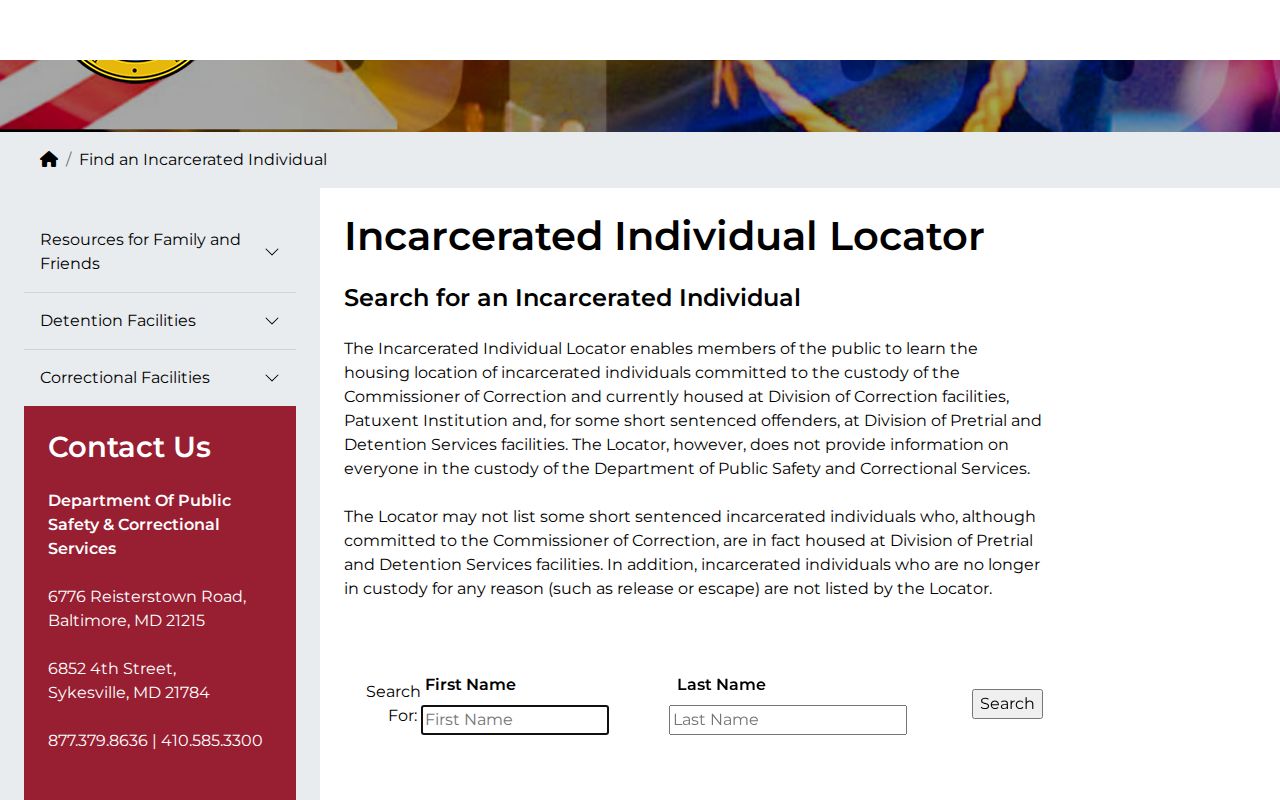
The DPSCS Incarcerated Individual Locator is a current-custody locator for a limited Maryland population, not a statewide archive of Baltimore County released inmates. It searches by first and last name and may return current housing information. Research found no public released or discharged profile, no release-history field, and no projected, tentative, anticipated, or mandatory-release-date field. A person who has left covered state custody may disappear, just as a released county detainee drops from an operational roster.
The official locator scope is visible in the source below. It helps rule in current covered DPSCS custody, but a no-result must be followed by BCDC, court, VINE, and receiving-agency checks.
For a state-prison release or sentence-computation record, use the DPSCS Public Information Act process. Do not send a BCDC-only request to the State simply because DPSCS runs the statewide locator.
When Does BCDC Release People?
No official BCDC release-processing hours, exit door, or weekend and holiday release schedule was located. A County applicant document describes public lobby and security-desk access during set daily hours, but those are not evidence that releases occur throughout that period. Call BCDC at 410-512-3200 before arranging pickup. Do not infer a physical-exit time from the date a judge signs an order, and do not wait at an undesignated door based on an unofficial listing.
A court action, record entry, and physical exit can occur at different times. Staff may still need to verify identity, process paperwork, return property, check holds, and determine whether another agency will receive the person. The narrow release-record request should therefore ask for date and time as separate fields.
Baltimore County Bond Release
Baltimore County operates Classification and Pretrial Services and Alternative Sentencing, while the court authorizes bail and release. Bond or pretrial release ends that immediate jail custody without disposing of the criminal case. The strongest confirmation pairs the court order with the BCDC release entry. County program material also describes GPS and other home-detention conditions, showing why a person may be outside the jail while remaining subject to restrictive community placement.
Check the Maryland case record for the judicial action, then verify the operational exit with Corrections or VINE. A docket alone cannot show that every hold cleared or that the person physically left at the moment an order was entered.
Baltimore County Reentry Programs
The BCDC volunteer portal identifies Re-entry and Rehabilitative Services, Education and Development, and faith-based programming. County planning sources also describe behavioral-health transition planning, medication-assisted-treatment referral, peer support, and community linkage. These names help people ask the facility about an existing program, but they do not establish eligibility, participation, or a release result.
Program participation should never be treated as evidence that custody ended. Confirm release through the release entry, court record, or VINE event, then use the appropriate program contact for navigation.
Property After BCDC Release
Schedule C-800 says confiscated property is inventoried and that, at release, the person signs a receipt and receives property plus a receipt copy. The signed copy enters the base file under the schedule's five-year rule. That receipt can identify what BCDC recorded as returned and support a focused inquiry about a disputed item. Courthouse Sheriff property follows a different policy, so a BCDC intake-property question should go to Corrections rather than the Sheriff merely because both offices are in Towson.
Request the releasable property receipt for the named stay and provide enough information to distinguish repeated custody episodes. The property record supports an inventory question; it does not replace the release entry or prove a later court disposition.
Baltimore County Court Release Records
Maryland launched an integrated Case Search and Record Portal in March 2026. Docket summaries can show charges, disposition, sentence, bond, release orders, warrants, probation, and later activity. Some favorable dispositions remain courthouse-only, and expungement or shielding can remove information from public view. An online absence therefore does not prove there was no case or no release.
The Circuit Court for Baltimore County is at 401 Bosley Avenue in Towson, while District Court matters may be handled at Towson, Essex, or Catonsville. Use the official Baltimore County court directory to identify the clerk holding the case. Court evidence answers what a judge ordered; BCDC evidence answers when county custody actually ended.
Baltimore County Release Supervision
Maryland's Division of Parole and Probation has a Towson Intake Unit and field locations serving Catonsville, Essex/Rosedale, and Owings Mills, plus a Baltimore Metro regional office. It offers an office directory, not a public name lookup. Parole, probation, mandatory supervision, and discharge are distinct statuses. A person can be out of physical custody and still have reporting duties, while statutory abatement under Correctional Services §6-117 can end active reporting without rewriting the case expiration.
Use the Baltimore County parole and probation office directory to route verification to the correct unit. A court docket or VINE event may indicate that supervision should follow, but the supervising agency is the source for current office assignment.
BCDC Release to ICE
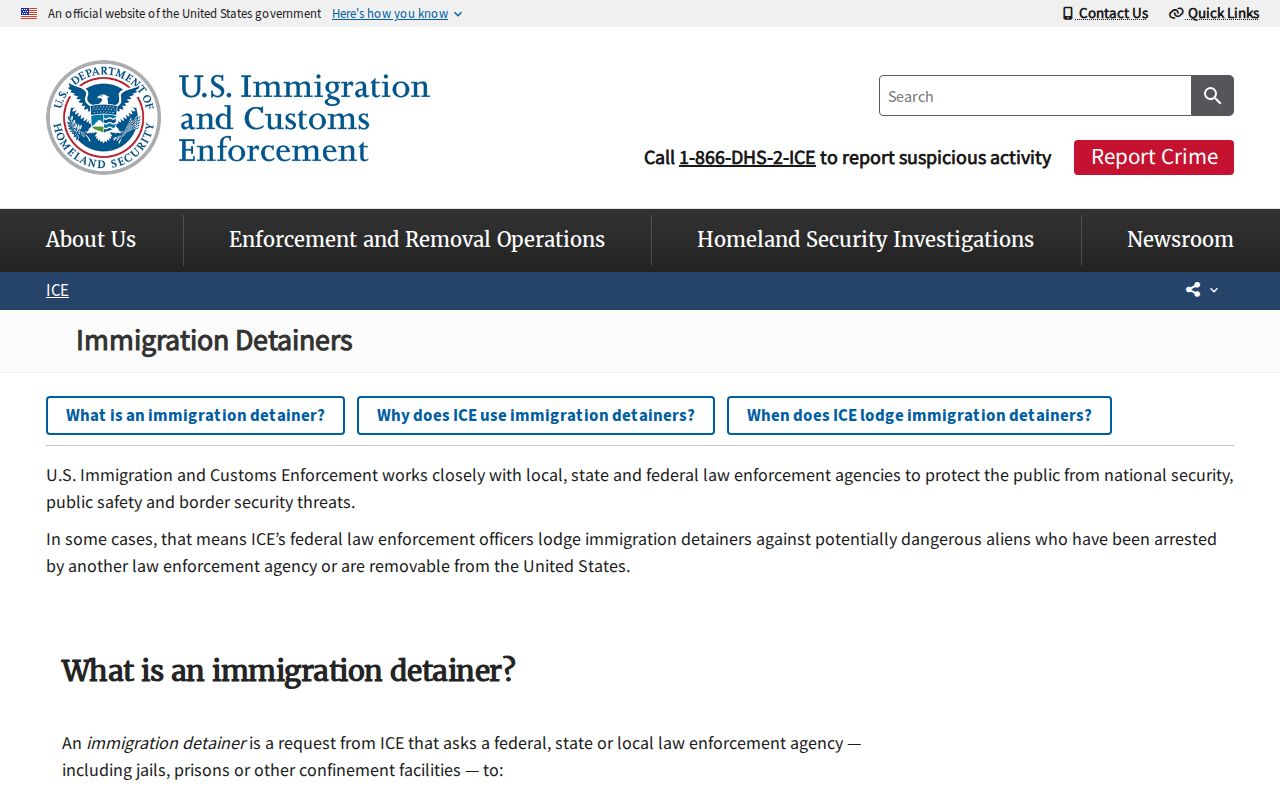
An ICE detainer can turn release from BCDC into direct federal immigration custody. ICE describes a detainer as a request for advance notice and for the local agency to maintain custody for up to 48 additional hours so ICE can assume custody. A county record marked transfer or release to ICE means Baltimore County custody ended; it does not establish that the person returned to the community.
Ask BCDC for the destination or receiving-agency field, then check the ICE Online Detainee Locator. The source image below explains the detainer context that makes this custody distinction important.
If immigration detention later ends, federal check-in instructions come from the person's ICE paperwork and are separate from Maryland parole, probation, and court obligations.
Choose the Correct Release Search
| Custody path | What the source covers | Historical release proof |
|---|---|---|
| Baltimore County jail | BCDC has no public current or released roster. | Daily Desk Report, Locator Card, Monthly Release List, or base file |
| Maryland state prison | DPSCS locator shows limited current custody, not released profiles. | DPSCS release/computation record and court order |
| Federal prison | BOP results can show “Released,” release date, and no current facility. | BOP result or federal record; older files may require FOIA or archives |
| Immigration custody | ICE locator emphasizes current custody, with a cautiously described recent-release window. | BCDC destination field plus ICE records |
| Community supervision | DPP office directory routes inquiries but does not search names. | Supervision agency record and court or parole order |
For federal custody, the BOP Inmate Locator is the notable public system that preserves explicit released-result information. It covers federal records from 1982 forward and updates daily. “Released” means outside BOP custody, not necessarily outside all justice systems.
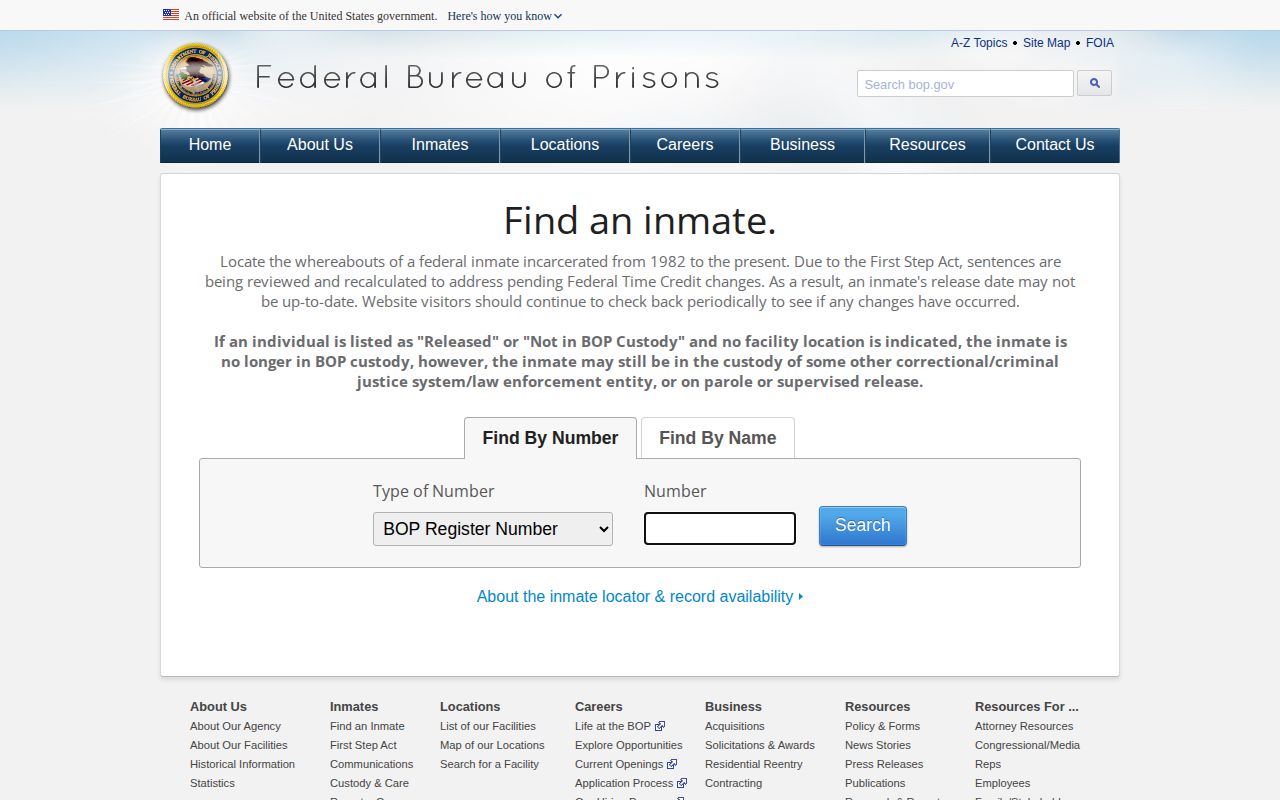
The BOP source should be used only for federal custody, never as a substitute for a Baltimore County detention record.
Baltimore County Detention Facility
The adult facility-page map contains one institution: Baltimore County Detention Center, a county jail operated by Baltimore County Department of Corrections at 720 Bosley Avenue in Towson. It holds pretrial detainees, locally sentenced people, and people in transit or other recorded statuses. Releases may go to the community or to another agency, so request the release type and destination before choosing the next locator.
The Charles H. Hickey, Jr. School in Parkville is a secure youth facility operated by the Maryland Department of Juvenile Services. Juvenile release records follow a different, generally nonpublic system, so it is intentionally excluded from the adult facility list.