
Baltimore County Three-Day Releases
The Baltimore County Department of Corrections publishes facility and agency information, but no inmate roster, booking-card archive, 72-hour release view, or historical released-person search. No public fields, update cadence, photo flag, or online retention window exist for such a feed. The Department of Corrections, not the Sheriff, operates the Baltimore County Detention Center.
A three-day check therefore starts from a likely person and date range. It does not create a list by collecting court cases, police news, or private roster pages. Those sources cannot reliably show who physically left BCDC, and they may blur Baltimore County with the independent jurisdiction of Baltimore City. The county release entry is the movement record that can resolve the question.
No rolling feed: Baltimore County has no official 72-hour release list, so verify the custody event through named public records.
Check Baltimore County 72-Hour Releases
Choose a start and end date that covers the possible exit. Then identify whether the person was held by BCDC, DPSCS, a federal authority, or immigration officials. A Baltimore County court case does not by itself prove BCDC custody, and a Towson-area address should not be used to assign a person to a facility.
- Search Maryland VINE for the named person and confirm the reporting facility or agency before reading the status.
- Use Maryland Judiciary Case Search to match the Baltimore County case, then review release, bail, disposition, sentence, warrant, and later order entries.
- Contact BCDC at 410-512-3200 and ask for the correct records or custody-verification route.
- Request the release entry or Daily Desk Report entry for the defined three-day span, including release date, time, type, and destination.
- Follow any transfer to its receiving system. Use DPSCS for state custody, BOP for federal custody, or ICE ODLS for eligible current immigration detention records.
If the likely event is confined to today, the Baltimore County same-day release process provides the narrower route. A smaller date range can reduce mistaken matches and records work.
Baltimore County Release Fields
Baltimore County displays no online 72-hour fields. A request can seek the corresponding fields from the BCDC release or discharge record. Ask only for what is needed, and include enough identifiers to distinguish the person. The release date without a destination is incomplete when a transfer may have occurred.
| Release field | How to read it |
|---|---|
| Name, date of birth, BCDC number | Matches the correct person and booking episode while allowing protected identifiers to be redacted. |
| Commitment date and authority | Connects BCDC custody to the court, warrant, sentence, or other legal basis. |
| Release date and time | Identifies the recorded county custody exit within the requested three-day span. |
| Release type or authority | Explains whether the event followed bond, recognizance, a court order, sentence completion, or another basis. |
| Destination or receiving agency | Shows whether the person entered the community or moved to another custodian. |
| Hold or detainer disposition | May explain why a court-authorized release did not result in an immediate community exit. |
Labels need context. “Time served” can complete the custodial part of one matter while another hold remains. Bond or recognizance is a pretrial release, not a final disposition. A transfer means the person left BCDC for another agency. It must not be described as freedom from all custody.
Baltimore County Weekend Releases
A 72-hour range is useful when the expected release sits near a weekend or legal holiday, but Baltimore County publishes no weekend release schedule or three-day catch-up feed. A county document that describes lobby and security-desk access does not establish release-processing hours. Do not infer an exit time, door, or pickup point from those lobby details.
The legal action and physical movement may also have different timestamps. A court can enter an order, detention staff can receive and verify it later, and another hold can affect the eventual destination. VINE may report the source’s status update rather than the moment of exit. Ask the BCDC custodian to distinguish the event date, entry date, and release time when those points matter.
For one named person, the Baltimore County release search and records guide helps reconcile the court docket with the custody source. It also explains why current-custody systems and historical release records should not be treated as interchangeable.
Baltimore County Release Archives
The absence of a public feed does not mean no release records exist. Baltimore County’s archival schedule identifies internal Population Status Reports that change continuously and update daily. It also names the Daily Desk Report for people received and released each day, a Monthly Release List package, a Locator Card Index, and a person-centered base file. These titles let a requester ask for a focused record rather than an undefined “72-hour list.”
The official Maryland Public Information Act Manual explains the state records framework. The image below shows that official source. It is the legal access guide, not a Baltimore County release roster.

For a three-day Baltimore County check, use the manual to frame a narrow request and the county schedule to name the record series. A date-centered Daily Desk Report request is often more direct than seeking all information in every base file.
The Baltimore County Corrections Schedule C-800 describes five-year retention for several working records and microfilm or permanent provisions for specified report and index material. Since the discoverable schedule is older, ask whether it has been replaced and request the current successor record when needed. The schedule supports access targeting. It does not turn the internal records into a live website.
Baltimore County Request Scope
A request for every person released across three days is broader than a person-specific request. It may require more search, preparation, review, and redaction. Privacy and statutory exemptions can also restrict parts of correctional, investigatory, juvenile, medical, victim, sealed, or expunged records. The Baltimore County PIA routing page identifies the public-record process. The County has not published a universal Corrections copy-fee sheet, so request electronic delivery and an estimate before chargeable work begins.
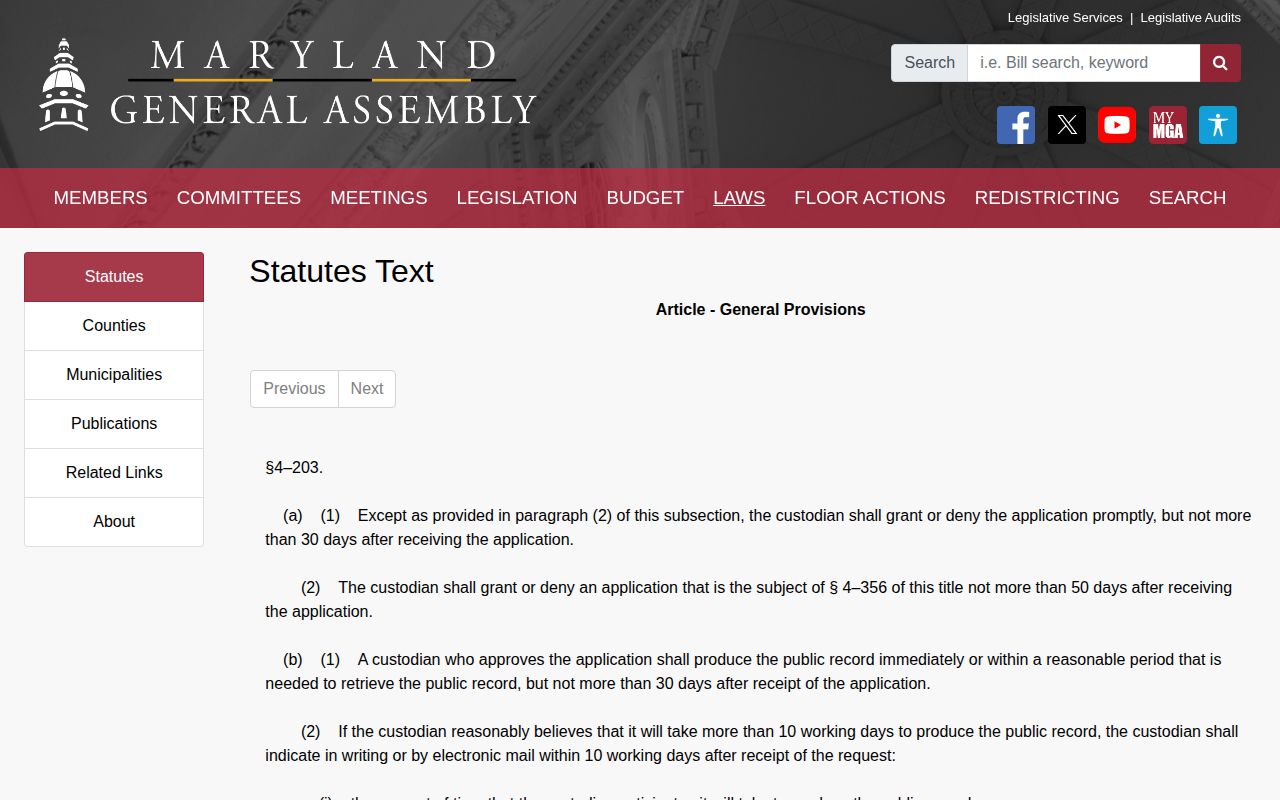
Maryland General Provisions §4-203 requires a prompt grant or denial and ordinarily a response within 30 days. If production is expected to take more than 10 working days, the law provides for a written status and estimate. Section 4-206 allows reasonable actual costs but does not permit a charge for the first two hours of search and preparation. A fee waiver can be requested under the statutory standard.
The official response-timing statute appears in the image below. It helps set expectations for a records request, but it does not promise same-day delivery of a broad release list.
A well-scoped request asks for the release entry, Daily Desk Report line, or Locator Card release date for one named person within the relevant span. Ask the agency to redact exempt parts and provide the remainder rather than seeking unrelated files.
Baltimore County Custody Routes
A three-day check must follow the correct custodian. BCDC records county pretrial and local-sentence movements. The DPSCS Incarcerated Individual Locator serves a limited current-state-custody purpose. It removes people no longer in state custody and does not provide a public released profile, release date, or projected date. A miss there is only a clue to check other sources.
| Possible status | Verification route |
|---|---|
| Community exit from BCDC | BCDC release record, with VINE and court entries as corroboration |
| Still held at BCDC | BCDC custody verification and Maryland VINE |
| Transferred to Maryland custody | DPSCS current locator, then the state commitment or release record |
| Transferred to federal custody | BOP locator or the responsible federal records route |
| Transferred to immigration custody | ICE ODLS plus the county release destination or detainer record |
The Maryland court docket may show the judge’s order and later case events, but it is not a movement log. VINE can provide a status or notification event, yet Maryland publishes no guaranteed released-result retention period. The county record is still needed when the exact historical time and destination must be established.
Baltimore County Release Verification
Submit a narrow request to the Baltimore County Department of Corrections at 720 Bosley Avenue, Towson, MD 21204, or ask corrections@baltimorecountymd.gov for the proper submission route. Include the full name, date of birth or BCDC number if known, and the three-day date range. Request the release date and time, release authority or type, transfer destination, and detainer disposition to the extent releasable.
If the exact day is uncertain, ask for the Locator Card Index release field or Monthly Release List entry. When a specific day is known, the Daily Desk Report is the stronger date-centered target. The base file can connect the release document, court authority, detainer, destination, and chronological summary. If the old series name is no longer used, ask for the current system containing the same fields.
Read the resulting records together. A release order shows legal authority. A BCDC entry shows the county movement. A receiving locator may show continued custody elsewhere. None should be expanded beyond its scope. That method gives a sound answer even though Baltimore County offers no public 72-hour release list.