
Baltimore County Parole vs Probation
Maryland separates the authority that orders a community status from the agency that manages it. The Maryland Parole Commission, often called MPC, decides parole matters. The Division of Parole and Probation, or DPP, supervises parolees, probationers, people on mandatory release, Drinking Driver Monitor Program cases, and some home-detention cases. DPP is part of the Maryland Department of Public Safety and Correctional Services.
Parole is conditional release before a sentence reaches its maximum expiration. The person remains under the sentence while living in the community. Probation is imposed by a court. It can follow jail, accompany a suspended sentence, or begin without incarceration. Release on bond, recognizance, or after dismissal does not by itself place someone under DPP supervision.
| Point | Parole | Probation |
|---|---|---|
| Starting authority | Maryland Parole Commission decision | Judge's order in the criminal case |
| Connection to custody | Conditional release from a correctional sentence | May follow custody or be imposed without a jail stay |
| Main verification record | MPC action plus an actual custody-release event | Court docket, signed order, and case file |
| Community agency | DPP field office | DPP field office when state supervision applies |
| End point | Discharge or sentence expiration, subject to the governing order | Court-ordered end, discharge, or expiration, subject to later action |
These terms should not be treated as synonyms. A parole approval is not an exact exit time, and a probation entry is not proof that a person was ever held at the Baltimore County Detention Center. The physical release and community-supervision status must be confirmed through their own sources.
- Parole
- Conditional release from incarceration before the maximum sentence expiration, with the sentence continuing under supervision.
- Probation
- A court-ordered community status with conditions, sometimes following a suspended or served jail term.
- Mandatory release
- A release based on the sentence term less applicable credits, usually with supervision for the unserved portion when the law requires it.
- Absconder
- A person alleged to have stopped required contact with supervision. The label does not erase the earlier lawful release.
- Discharge
- The formal end of the applicable supervision or sentence obligation, as shown by the controlling agency or court record.
Verify Baltimore County Release Supervision
There is no official public statewide DPP name-search database for every Maryland parolee or probationer. The DPP website locates offices, not people. Verification therefore requires a short chain of records. Use a full name with a date of birth, case number, State Identification number, or DPSCS number when lawfully available. A same-name match alone is weak evidence.
- Identify the Baltimore County case. Search the Maryland Judiciary Case Search, select the correct county and case, and inspect the sentence, suspended portion, probation term, and later docket entries.
- Separate probation from parole. A court order supports probation. For parole, review the MPC hearing or action record, but do not treat a hearing date or approval as proof of physical release.
- Confirm the custody event. Check Maryland VINE or request the BCDC or DPSCS release record. A transfer to state, federal, immigration, or another county custody is not community supervision.
- Find the assigned DPP office. Use the official office directory because Baltimore County has several intake and field locations and assignments can change.
- Ask through the proper channel. Contact the office or submit a DPSCS public-record request with enough identifiers. Privacy rules may limit what staff may disclose.
- Check later changes separately. A violation, warrant, abatement, revocation, or discharge may appear after the first release record and should be tied to its own date and source.
A person missing from the jail roster is not automatically on parole or probation; first confirm the actual release or transfer event.
The Baltimore County released-inmate search path explains how the county movement record, court docket, VINE event, and receiving-agency result fit together. Those sources establish whether the person reached the community before DPP status is interpreted.
Baltimore County Supervision Offices
Baltimore County does not have one field counter for every case. The official DPP office directory identifies a Towson intake unit, three field locations, Drinking Driver Monitor Program sites, and a Baltimore Metro regional office. The office nearest a home address is not always the assigned office. Confirm the location before sending a record inquiry or appearing in person.
Towson Intake Unit
200-B Washington Avenue, Ground Floor
Towson, MD 21204
410-832-2200 or 410-832-2300
Catonsville Field Office
1 Rolling Cross Road, First Floor, Suite 110
Catonsville, MD 21228
410-512-2400
Essex/Rosedale Field Office and DDMP
8914 Kelso Drive
Baltimore, MD 21221
410-238-5500
Owings Mills Field Office and Baltimore Metro Regional Office
10221-B Dolfield Road
Owings Mills, MD 21117
410-902-3380
DPP Headquarters
6776 Reisterstown Road, Suite 212
Baltimore, MD 21215
410-585-3500 or 877-227-8031
dpscs.dpp@maryland.gov
The directory screenshot below comes from the DPSCS Baltimore County office lookup.
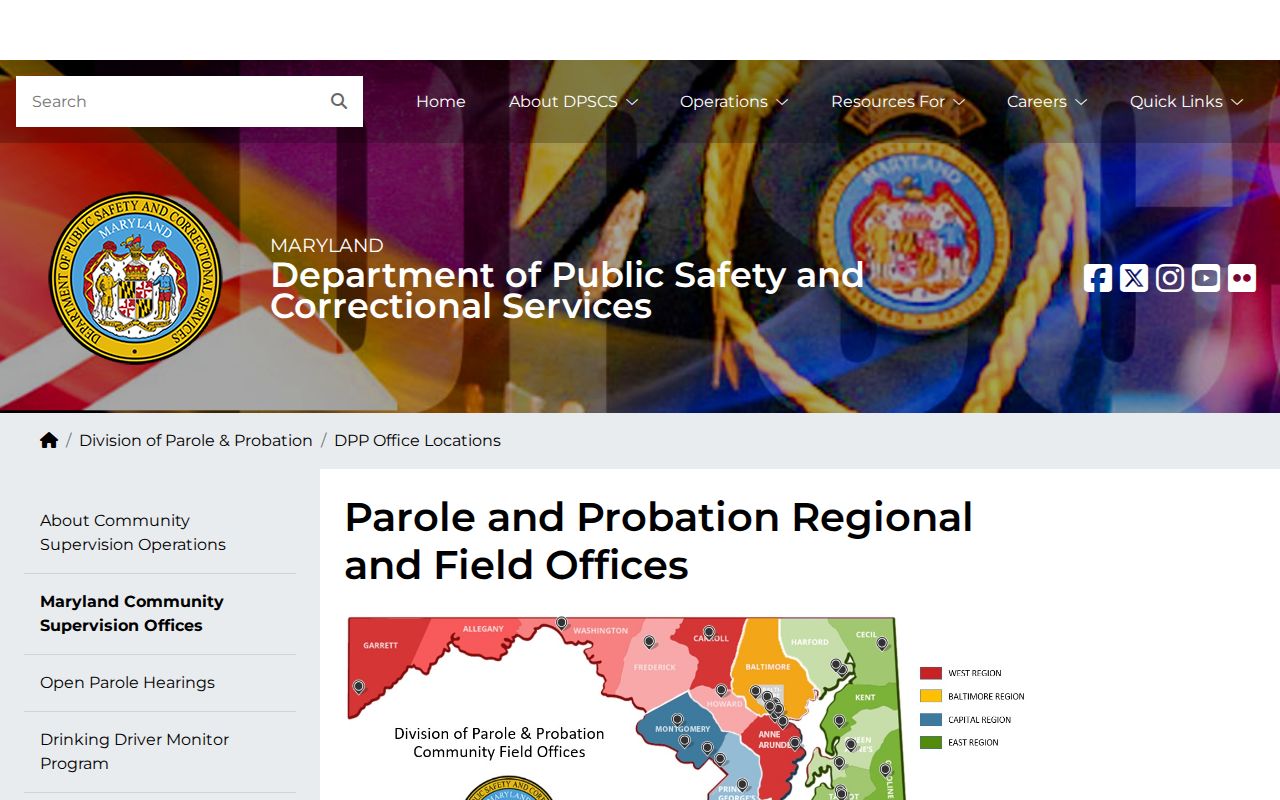
It shows why office assignment must be checked at the state source instead of inferred from a city name or ZIP code.
These contacts help route an inquiry. They are not a public invitation to obtain confidential case notes or a person's private reporting details. Supply a case number or DPSCS identifier and ask what public process applies.
Baltimore County Supervision Changes
Conditions come from the court order, parole action, release plan, or supervision record. Common conditions can require regular reporting, compliance with location or travel rules, program participation, and obeying court orders. The controlling document matters. A general description cannot establish the terms in one Baltimore County case.
A reported violation is an allegation that a condition was breached. Revocation is the formal action that cancels parole or changes the status after the required process. An absconder allegation generally means the person is said to have stopped required contact. Maryland DPP has a Warrant Apprehension Unit, but the research found no official statewide public absconder or wanted-person name list for all supervisees. Do not substitute an unofficial list for a warrant record or agency response.
Maryland VINE may provide parole or probation status-change notices for a registered person. It is a notification tool, not an archival supervision certificate. Maryland materials do not promise seamless tracking through every local-jail, state-prison, court, and supervision transition. Search again and re-register when the custody source changes. For a past event, request the underlying court, MPC, or DPP record.
Note: A later violation or warrant changes the later status; it does not mean the earlier Baltimore County release never occurred.
Baltimore County Parole Hearing Records
An MPC hearing schedule shows consideration, not release. The Commission's open-hearing master list may identify the date, time, institution or hearing site, name, and DOC number for covered open proceedings. It does not include all hearings and is not a searchable results database. MPC public meetings, held on a separate business calendar, also do not prove an individual outcome.
MPC describes three core outcomes. “Refuse” means no further parole hearing. “Rehear” means reconsideration at a later stated point. “Approve” means release may follow after required pre-release conditions are met. Other terms, including defer, rescind, and revoke, must be read in the specific order. Under Correctional Services §7-304, qualifying open hearings involve public-vote rules, while deliberations may close and attendance may be limited.
No general public Maryland database of individual MPC decisions was located. Ask MPC for the releasable action or vote record, use registered-victim services where applicable, and pair a favorable action with a VINE or corrections release event. Approval can precede the physical exit while plans or conditions remain unresolved.
Baltimore County Supervision Discharge
Parole does not end merely because a person left a correctional facility. MPC describes it as conditional release while the sentence continues under DPP supervision until the maximum expiration date, unless another lawful action changes that result. A violation can lead to revocation and a return to custody. Probation likewise follows the term and conditions in the court order, including any later modification.
Maryland also recognizes abatement under Correctional Services §6-117. For eligible compliance, the active-supervision portion can be reduced by credits described in the statute. When the required time and credits are met, abatement can end active reporting or home detention as specified. It does not rewrite the legal expiration date or erase duties that continue under law.
The statute screenshot below is from the official Maryland abatement provision.
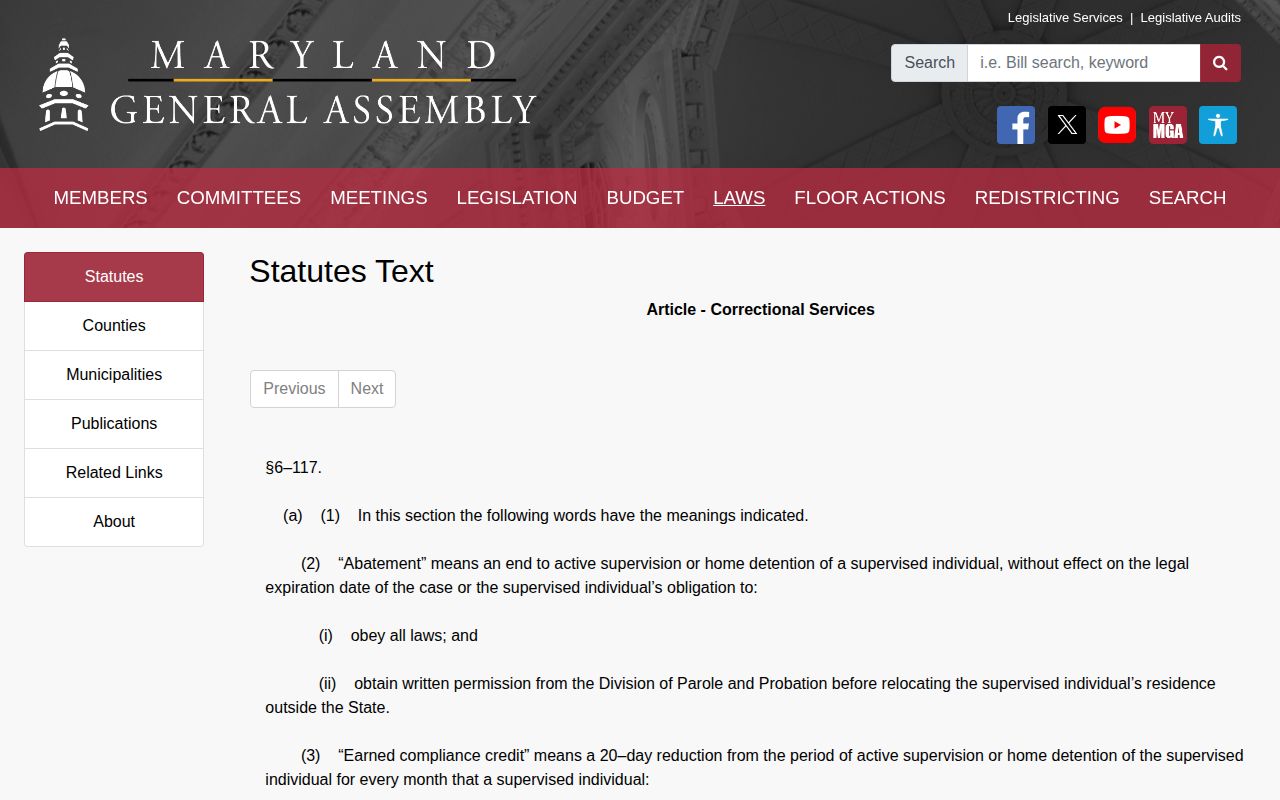
The text supports a key distinction: no active reporting is not the same as full discharge from the case.
For final verification, request the discharge, expiration, abatement, or termination entry from the agency or court that controls it. Record the effective date and the legal status stated in the document. Do not infer discharge from a missed web result.
Baltimore County Release Reentry Services
The official BCDC volunteer portal names Re-entry and Rehabilitative Services, Education and Development, and faith-based programming. The County Corrections programs page identifies the local correctional program structure. County behavioral-health planning materials also describe mental-health transition planning, medication-assisted-treatment referral, peer support, and links to community services. These are documented programs and referral paths. They are not promised benefits for each released person.
Reentry support and DPP supervision serve different roles. A treatment referral or education contact does not prove parole, probation, or a release date. Likewise, a DPP reporting requirement does not establish that a particular BCDC program was received. When coordinating a return to the community, use the release paperwork for immediate instructions and the assigned supervision office for case-specific reporting duties.
Baltimore County Release Property Receipt
Baltimore County Corrections Schedule C-800 says confiscated property is inventoried. At release, the person signs a receipt and receives the property with a copy of that receipt. Another copy remains in the base file under the schedule's five-year rule. The signed document can help resolve a dispute about what BCDC returned.
The BCDC receipt is separate from property held by the Baltimore County Sheriff at the courthouse. Those agencies follow different records and property procedures. A request should name the detention-center stay, approximate release date, and the release-property receipt rather than asking broadly for “Sheriff property.” If the record series has changed, ask the Corrections custodian for its current successor.
Note: Property paperwork documents the return of listed items; it does not establish whether later parole or probation reporting requirements were satisfied.